Every Monday, four analysts spent forty minutes each pulling AI SEO tools data into a client deck: that is 138 hours a year lost to copy-paste. The numbers were stale by Tuesday. Since about 68% of US Google searches ended without a click in early 2026, up from roughly 60% in 2024, watching SERPs by hand is a losing game, and the pull should be automated. The stack below deletes most of that ritual: it replaces the fetching and formatting that eats a junior’s week, not the judgment.
My filter: a tool you cannot script against is not part of a stack, it is a tab you forget to open.
What makes a tool stack-able:
- API access with predictable credits, so a scheduled pull does not silently die mid-report.
- MCP or agent support, so an assistant queries it directly instead of scraping a UI.
- Automation hooks into Make, n8n, or Zapier.
- Exportable data as JSON or CSV, not trapped behind a login.
- A known failure mode you can budget for: rate limits, credit budgets, or schema drift.
Every entry was scored on build cost and maintenance cost, the number vendors never show you, not feature-list length.
How the 6 AI SEO tools compare
| Tool | API access | MCP / agent | Automation hooks | What you automate | From /mo |
| 1. SE Ranking | Yes, every plan | MCP, every plan | Make, n8n, Zapier | Data pulls, reports, AI-visibility | $129 |
| 2. Ahrefs | Yes, paid on top | No native MCP | Via API | Backlink and rank data pulls | $129 |
| 3. Semrush | Add-on or limited | Limited | Via API | Keyword and audit data | $117 |
| 4. Surfer SEO | Higher tiers | No | Via API | Content scoring in a pipeline | $49 |
| 5. SEO.AI | Limited | Agent-based | Some | Drafting and publishing | $149 |
| 6. Alli AI | Yes | No | Deploys changes | On-page and technical edits | $249 |
How to read this stack
The question is not which tool is best, it is which tool you can automate against. API access, MCP or agent support, and exportable data decide whether a tool joins a pipeline or stays a manual dashboard. Read the last three columns first: they show what you stop doing by hand.
Step 1: Pull rankings and AI-visibility data on a schedule
The first thing to automate is the data pull. Budget two to four hours to wire one API key into a scheduled job; then a cron beats four people exporting CSVs every Monday.
1. SE Ranking
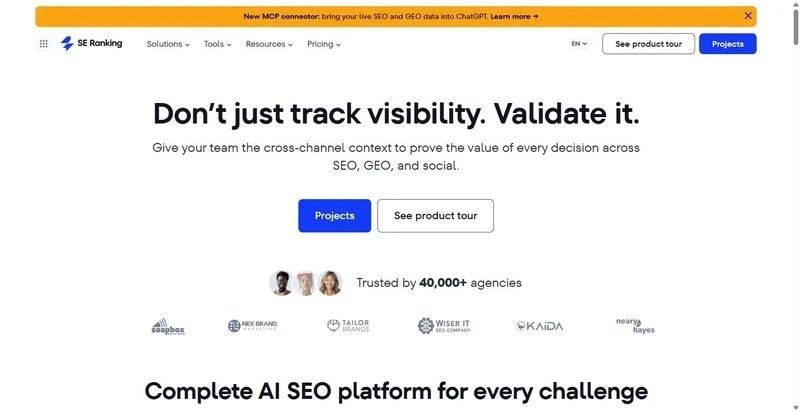
An SEO and AI search visibility platform whose API and MCP ship inside every plan, so the data layer is not a separate purchase.
Best for: agencies and in-house teams that want ranking, audit, and AI-visibility data flowing into their own reporting.
Standout feature: API and MCP come in every plan, not walled behind a higher tier, so one API key and one scheduled job pull rankings, audit deltas, and AI-visibility across five engines into your warehouse. Worth pulling the AI data now: Google AI Mode passed 1 billion monthly users by mid-2026.
Pros:
- API and MCP included in every plan, no add-on line to approve.
- Data API ships 25,000 credits on Core and 100,000 on Growth.
- MCP server you can query straight from Claude, ChatGPT, or Cursor.
- Make, n8n, and Zapier hooks for the no-code jobs your ops team owns.
Cons (where this breaks):
- Credit budgets need watching once you schedule heavy daily pulls.
- Some AI-visibility depth sits behind the AI Search add-on.
- A few Insights only populate with a connected Google Search Console.
Pricing: Core $129/mo ($103.20/mo billed annually), Growth $279/mo. API and MCP are included in every plan.
Build-vs-buy verdict: Make this the backbone, because the data layer costs no extra licence. You wire the API endpoints once, schedule the pull, and spend engineering hours on transforms instead of scraping.
2. Ahrefs

A backlink and rank data platform with a deep index and a clean query model.
Best for: teams whose reporting leans hard on link data and competitor crawl depth.
Standout feature: Strong backlink and rank data sit behind a solid, well-documented API, but access is a paid line billed on top of your plan seat. The endpoints are clean and the numbers reliable, so the pipeline is straightforward once the budget for API rows is signed off.
Pros:
- Deep backlink index for link reporting.
- Well-structured API with predictable responses.
Cons (where this breaks):
- API credits meter fast on daily bulk pulls.
- API is an add-on cost, not bundled with the seat.
Pricing: Lite $129/mo, Standard $249/mo; API billed separately.
Build-vs-buy verdict: Buy it when link data drives your reports and the separate API spend is approved; for rankings only, a bundled option is cheaper.
3. Semrush
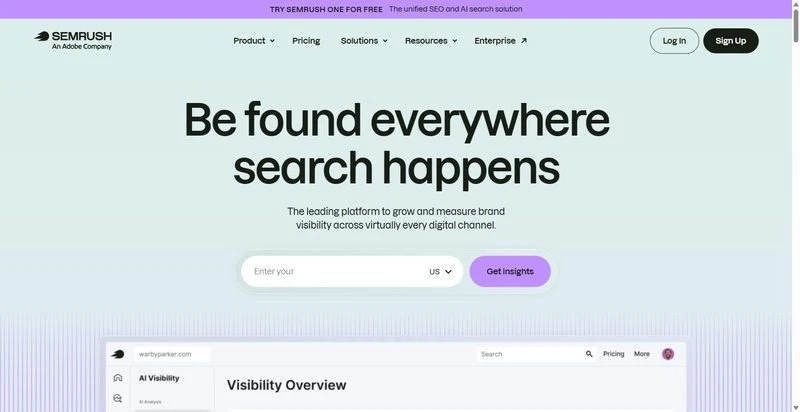
A broad SEO and marketing suite covering keywords, rankings, audits, and competitive data.
Best for: teams that want one wide data set and can plan around metered pipeline costs.
Standout feature: The data set is broad and the API is available, but calls are metered and often gated as an add-on, so pipeline costs need planning before you schedule anything. Model your call volume first: a daily bulk job at scale becomes a line item finance will notice.
Pros:
- Wide coverage across keywords, ranks, and audits.
- Large keyword and domain database.
Cons (where this breaks):
- Metered API calls make heavy schedules expensive.
- API access often sits behind an add-on.
Pricing: SEO plan from about $117/mo (billed annually), Pro+ $248/mo.
Build-vs-buy verdict: Buy it for breadth when one wide suite matters more than a lean data bill; if the schedule is heavy, price the metered calls first.
Step 2: Draft and optimise content without a human in every loop
Content is where automation earns back the most hours: drafting, scoring, and internal linking no one wants to do by hand. Automate the first draft and the optimisation pass, then hand it to an editor. The honest limit: a human still reviews every piece before publish, because that review keeps weak output off the index.
4. Surfer SEO

Surfer SEO scores drafts against the SERP and feeds that check into your pipeline.
Best for: teams putting content scoring into a pipeline.
Standout feature: Content optimisation with an API on the higher tiers, so scoring runs as a build step in your CMS instead of a manual paste-and-check. Editors get a score before publish, which turns a suggestion into a gate.
Pros:
- SERP-based scoring with a clear target.
- API turns the score into a pipeline gate.
Cons (where this breaks):
- Output still needs an editor before publish.
- The API lands only on higher tiers, so pipeline plans start at real money.
Pricing: Discovery $49/mo, Standard $99/mo, Pro $182/mo.
Build-vs-buy verdict: Buy the scoring, do not build it: a SERP model plus upkeep is months of engineering time. Wire the API in as a gate, then budget review hours per draft.
5. SEO.AI

SEO.AI runs as an agent that drafts and monitors content for Google and ChatGPT visibility.
Best for: teams automating first drafts at volume.
Standout feature: Agent-based drafting and publishing that runs on a schedule, so the queue fills itself overnight. The caveat is real: the agent needs guardrails and a human review pass, because unattended publishing is how bad drafts reach the index.
Pros:
- Drafts at volume on a schedule.
- Monitors for Google and ChatGPT visibility.
Cons (where this breaks):
- Agents need scoping before you trust the queue.
- Output needs editing, so you still staff review.
Pricing: Single Site $149/mo, Multi Site $299/mo.
Build-vs-buy verdict: Buy this to fill a drafting queue, not to replace an editor. Scope its prompts, cap what it publishes, and staff a review pass. Treat the output as a first draft.
Step 3: Deploy on-page and technical changes automatically
This is the riskiest step to automate, because a bad push hits every page at once, so build a rollback plan first. With ChatGPT alone reaching about 900 million weekly active users in early 2026, pre-rendering for AI crawlers is the reason it is worth the risk.
6. Alli AI
Alli AI deploys AEO, GEO, and SEO changes across a site and pre-renders content for 50+ AI crawlers.
Best for: teams shipping on-page and technical edits at scale without a rebuild.
Standout feature: Bulk deployment of on-page optimisations plus pre-rendering for AI crawlers, which is the automation other tools leave you to build. Changes push through a script layer over the DOM, so you ship edits without a dev sprint.
Pros:
- Deploys edits across a site in bulk.
- Pre-renders for 50+ AI crawlers.
Cons (where this breaks):
- Automated changes still need a review before they push live.
- The price step to Business is steep.
Pricing: Business $249/mo ($299 month-to-month).
Build-vs-buy verdict: Buy this to automate the deploy step, the part most teams still do by hand. Keep a rollback plan and a review gate, because automated on-page changes at scale can break as fast as they ship.
Step 4: Wire an AI agent to your SEO data via MCP
The last step is querying live SEO data in plain language through MCP, which SE Ranking ships in every plan. Scope what the agent can see and set a credit ceiling on the API side, not in the prompt, or one vague question burns a week’s budget. Runnable today: add the MCP server, scope three query patterns, set the ceiling.
Assembling your own stack
Make SE Ranking the backbone. The API and MCP are included in every plan, so your data layer needs no extra licence and no separate contract negotiation. The ledger is simple: build when you have engineering hours and genuinely unusual requirements, and buy the standard 80% that every vendor already solved.
Do the hours math first. If a task runs twice a quarter, automating it never clears its cost, so leave it manual. If your bottleneck is content rather than data, the honest alternative is Surfer SEO or SEO.AI as the writing layer on top of the same SE Ranking data. Build the plumbing once and keep it boring.
FAQ
Which AI SEO tools have an API and MCP access included?
SE Ranking includes both the API and the MCP server in every plan, which is why it makes a clean data backbone. Others expose an API but gate it behind higher tiers or bill it as an add-on, so confirm the ceiling and per-call cost first.
Can you automate SEO reporting without engineering headcount?
Yes, for the standard 80%. No-code hooks through Make, n8n, or Zapier pull the SE Ranking API into a scheduled report without a line you maintain. Keep engineering for the unusual requirements. If a report runs monthly and takes ten minutes by hand, leave it manual.
Where do automated AI SEO pipelines usually break?
Three places, every time: rate limits when a batch fires too fast, credit budgets when an agent loops on a vague query, and schema drift when a vendor renames a field and your parser returns nulls. Alert on empty payloads and cap credits at the source.
Is it worth building your own stack or buying an all-in-one platform?
Buy the standard 80%, build only the unusual 20% you have hours to maintain. An all-in-one like Semrush or Ahrefs covers breadth; a scoped SE Ranking backbone plus targeted automation covers depth.