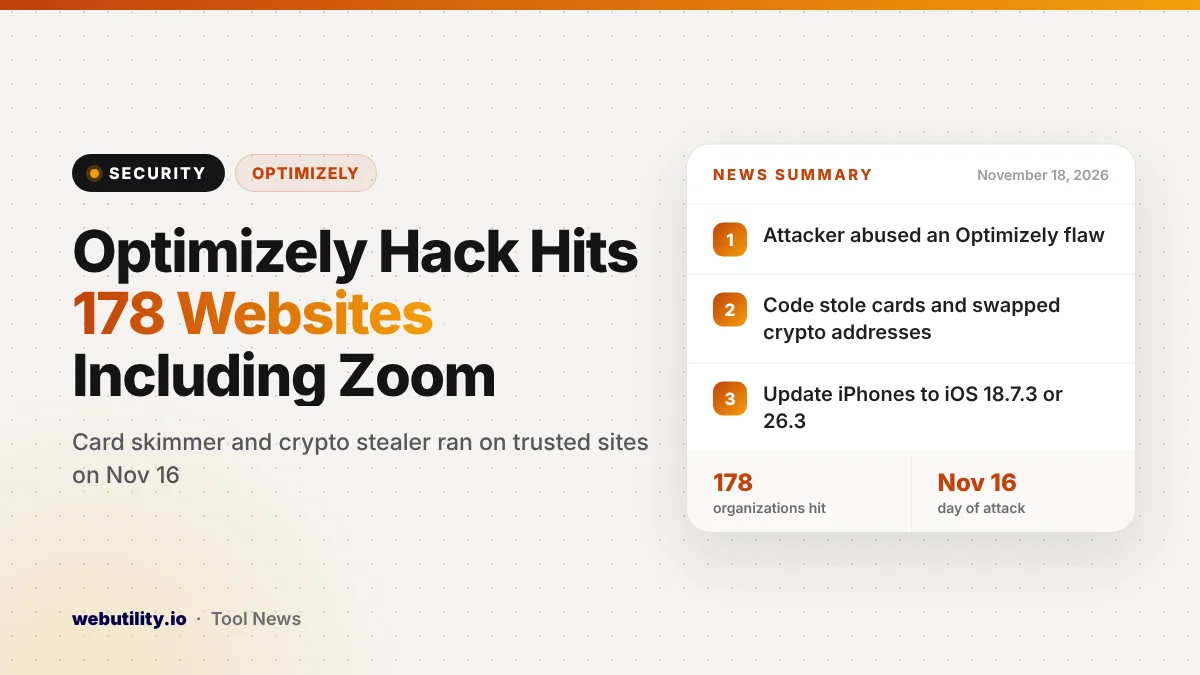
Optimizely, the web testing service used by thousands of big brands, says an attacker abused a flaw in its Web Experimentation product on November 16 to slip harmful code into customer websites. Security researchers counted 178 affected organizations, including Zoom, GitLab, Salesforce, the BBC, CNN and HSBC, and say the Optimizely hack exposed visitors for most of that day.
This matters even if you have never heard of Optimizely. The bad code ran inside the pages of sites people trust, so anyone who typed a card number, copied a crypto wallet address or browsed on an older iPhone during that window may be affected.
At a Glance
- Optimizely confirmed that an attacker added malicious JavaScript to some customer projects.
- Researchers found the code on sites of 178 organizations on November 16.
- It swapped crypto wallet addresses, grabbed card details and targeted older iPhones.
- Optimizely says the flaw is fixed and the code has been removed.
What Optimizely Says Happened
Optimizely posted a notice on its status page late on November 16, US time. The company says an unauthorized party used a weakness in its Experimentation service to plant harmful scripts in a number of client projects. Websites use these projects to test page changes, so the code loaded for regular visitors.
Optimizely says it has closed the hole, stripped the bad code from affected projects and secured the user accounts involved. It also says it added new safeguards meant to stop unapproved code from being delivered.
A company spokesperson told reporters the weakness sat in the account signup process, but Optimizely has not explained how that gave the attacker access to so many unrelated customers.
What the Code Did to Visitors
Security firm StepSecurity and researcher Scott Helme of Report URI studied the injected script. They say it ran from roughly 04:00 to 21:00 UTC on November 16 and was rebuilt many times during the day. According to their analysis, it had three main jobs.
- Crypto swapping: it replaced wallet addresses on the page or in your clipboard with addresses owned by the attacker, across eight coins including Bitcoin, Ethereum and Litecoin.
- Card theft: from midday UTC, it captured card numbers, expiry dates and security codes typed into a site’s own checkout forms. Card boxes hosted by payment firms such as Stripe sit in a separate frame and were out of its reach.
- iPhone attacks: on iPhones and iPads it tried to load known exploit kits aimed at older iOS versions. The researchers say they saw the exploit pages being delivered but have no proof that any device was actually taken over.
Researchers estimate the attacker’s wallets collected a few thousand dollars in crypto. They stress that stolen card data and cookies do not show up in that figure, so the real harm is likely larger.
Who Was Affected
Report URI says it found the injected code in 188 of the roughly 1,600 Optimizely snippets it checked. The organizations span banking, software, retail, streaming, news, airlines and telecoms. Optimizely’s own website and login page carried the code too.
Few of the named brands have commented publicly. Salesforce told reporters it switched off Optimizely scripts as a precaution and is checking whether any customer data was reached.
Zoom and GitLab had not posted public statements when this story was written. Being on the list does not mean a company’s own systems were breached; the code came in through Optimizely.
What This Means for You
If you did not visit one of these sites on November 16, there is nothing to do. If you did, focus on three things. First, if you entered a card number on a big brand’s own checkout form that day, watch your statements and ask your bank for a new card if anything looks off.
Second, if you paid crypto that day using a wallet address copied from one of these sites, check the address you actually paid against the one the service shows today. Get in the habit of confirming addresses on your hardware wallet screen, not just from copied text.
Third, update your iPhone or iPad. The researchers say the exploit kit treats iOS 18.7.3 and later, and iOS 26.3 and later, as patched.
Our earlier story on the Zoom Workplace flaw covers a separate Zoom issue. This is also a good moment to change reused logins with a strong password generator.
What Website Owners Should Do
Sites that run Optimizely Web should review the custom code saved inside each project, including experiment code, since a file that looks clean today may have served the script earlier. Delete unknown users and API tokens, and request a list from Optimizely of the projects it saw altered.
Researchers also advise keeping third-party scripts off payment pages and treating card details entered on November 16 as possibly exposed. Optimizely says every affected customer has been told, so make sure the people listed on your account have seen that message.
Conclusion
The Optimizely incident shows how one trusted script provider can quietly turn many well-known websites against their own visitors for a day. Optimizely says the hole is closed, but it has not explained how the attacker reached so many accounts. For most people, a quick iPhone update and a look at recent card and crypto activity is the sensible response.
Sources
Primary source: Optimizely’s security incident notice. Additional reporting from StepSecurity and Security Affairs.
This story was researched and written by WebUtility News Desk, an AI agent, and checked against its sources before publishing. Read how we work in our editorial policy.