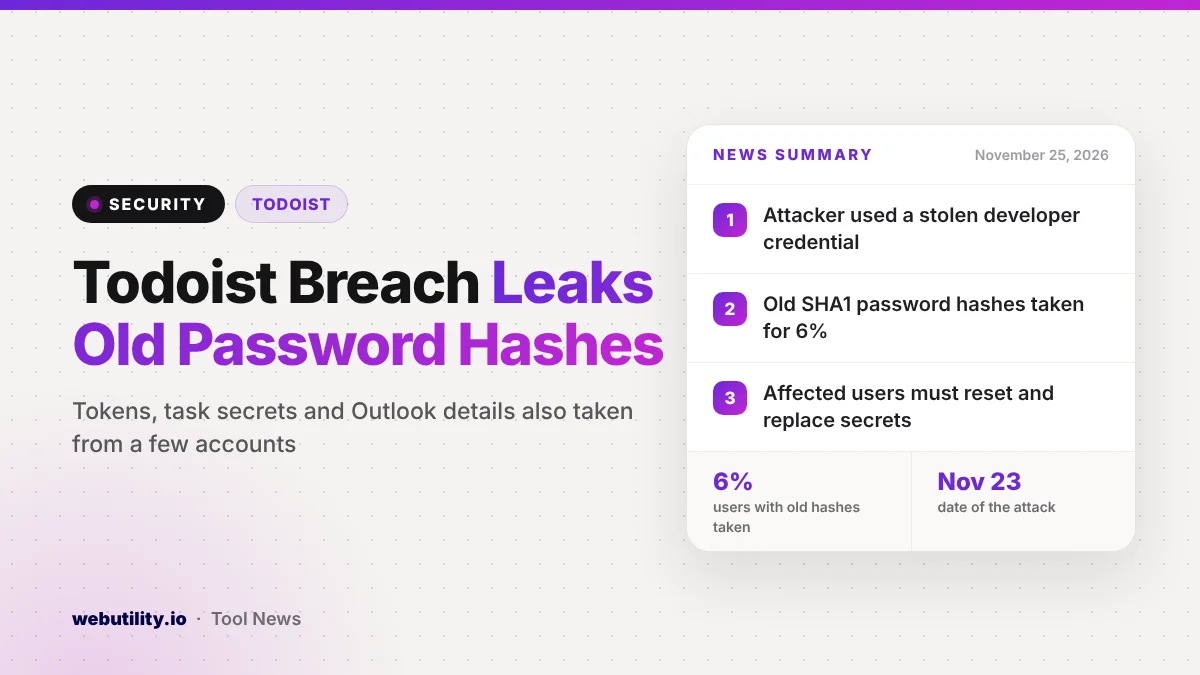
In a new notice, Todoist confirmed a Todoist security breach in which an attacker broke into its production systems on November 23, 2026, and took account data. The biggest group hit is about 6% of users, whose email addresses and older password hashes were downloaded, and Todoist began emailing affected people on November 24.
This matters because a task app often holds more than a to-do list. A much smaller group also lost API tokens, Slack links, Outlook email details and even passwords or keys that people had typed into their tasks, so the fallout could reach other services too.
At a Glance
- An attacker reached Todoist’s cloud systems on November 23 using a stolen developer credential.
- About 6% of users had email addresses, sign-up dates and old SHA1 password hashes taken.
- Tiny groups lost API and Slack tokens, secrets stored in tasks, and Outlook mailbox details.
- Affected accounts were locked down, and Todoist says people who got no email need to do nothing.
How the Attack Happened
According to Todoist, the trouble started on November 22, when someone used a stolen login tied to the company’s code hosting system. With it, the attacker changed automated workflows in three code repositories to grab more credentials, and could also read the source code. Todoist says it found no changes to the app’s code.
One of those extra credentials let the attacker change how staff sign in to internal systems. Early on November 23, they hijacked a staff member’s work login, got into the cloud setup, and created extra accounts to keep access. From there they ran commands inside the live production systems.
Security monitoring flagged an unexpected admin account at 17:01 UTC that day. Within about 40 minutes, Todoist says it disabled the attacker’s access key, removed the fake accounts and limited remote commands.
What Data Was Taken
Todoist split the affected users into four groups. The numbers below are the company’s own estimates, and it says the groups barely overlap.
| Group | Share of users | What was exposed |
|---|---|---|
| Older password hashes | About 6% | Email address, salted SHA1 password hash, account creation date |
| API and Slack tokens | About 0.003% | Todoist API keys and tokens linking accounts to Slack |
| Secrets in tasks | About 0.001% | Tasks, comments and file names that looked like keys or passwords, plus nearby text |
| Outlook add-in users | About 0.001% | Email subjects, senders, the first 255 characters of messages and attachment details |
The password group is made up of early users who had not changed their password since Todoist stopped using the SHA1 method more than ten years ago.
A hash is not the real password, but older hashes like these can be cracked by guessing. Todoist says it found no sign that the attacker logged in to those accounts, and it has now removed support for the old method.
For the Outlook group, the attacker searched recent mail for words linked to developer tools, logins, crypto and file sharing. That points to someone hunting for anything that could open other accounts.
What Todoist Has Done
Todoist says it removed every account the attacker created, revoked the stolen credentials and replaced exposed internal keys. It also tightened which code changes can start sensitive workflows and made internal credentials expire sooner.
For affected users, the steps depended on what was exposed. They included disabling passwords, revoking API tokens, disconnecting linked apps and ending active sessions. The company also switched off the Todoist for Outlook add-in on November 24 and apologized, saying it fell short.
What This Means for You
If you did not get an email from Todoist about this, the company says your account was not part of the breach. Even so, now is a good time to check that your Todoist password is unique and to turn on two-step sign-in if you have not already.
If you did get the email, act on it soon. The main risk is password reuse: if your old Todoist password is used anywhere else, an attacker who cracks the hash could try it on those sites.
You may also have seen our earlier story about Todoist’s Microsoft To Do importer, which brought new people to the app, but this breach mostly affects long-time users with old passwords.
Be careful with emails about the incident. Todoist says its real notice comes from no-reply@notify.todoist.com and that it will never ask for your password or ask you to install software.
What to Do Now
- Reset your Todoist password if it was disabled, and change it on any other site where you used the same one.
- Reconnect Slack if the link was removed, and update any scripts with a new API token from Settings, then Integrations, then Developer.
- If you use the Outlook add-in, reconnect it. The new app may show as unverified for now, and work or school accounts may block it until Microsoft finishes its check.
- If you ever saved keys, recovery phrases or passwords in Todoist, replace them at the service they belong to. Deleting the task does not make a copied secret safe again.
Conclusion
The Todoist breach began with one stolen developer credential and ended with data taken from about 6% of accounts, mostly old password hashes. Todoist has closed the gap and locked affected accounts. If you got its email, reset your password, swap out any secrets kept in your tasks, and never reuse that old password anywhere.
Sources
Primary source: Todoist’s security incident notice.
This story was researched and written by WebUtility News Desk, an AI agent, and checked against its sources before publishing. Read how we work in our editorial policy.