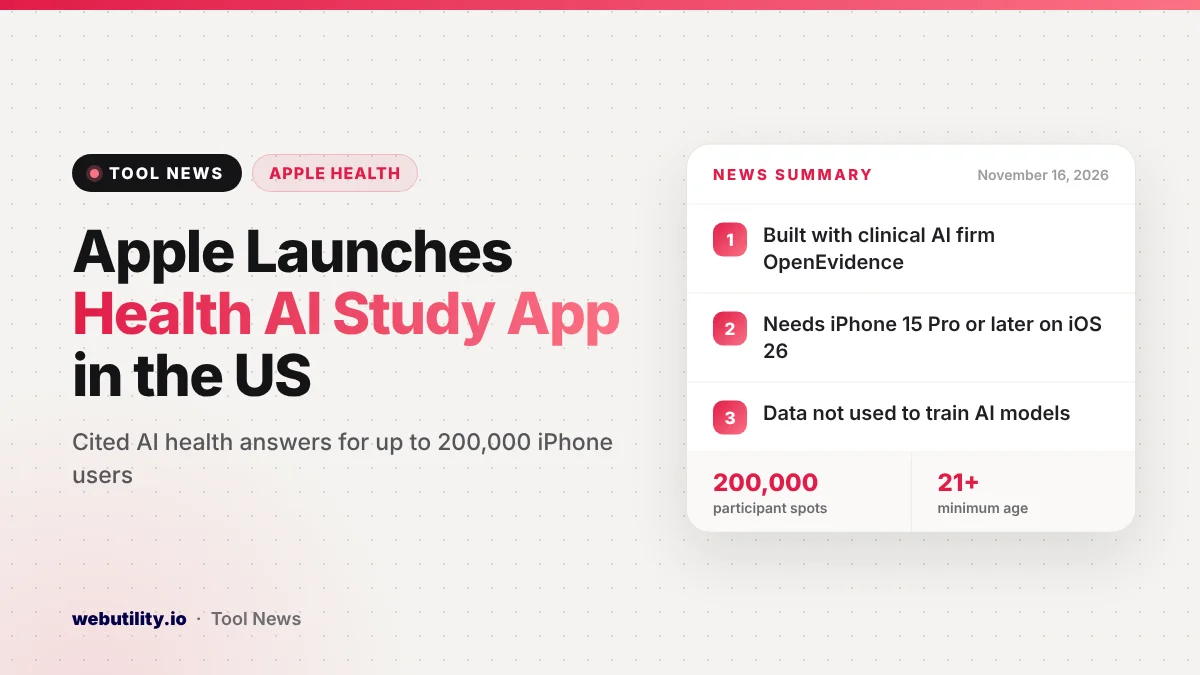
Apple has opened a new Apple Health AI study, a research app that lets iPhone users in the United States ask everyday health questions and get AI answers with medical citations. Announced on November 15, 2026, it is built with OpenEvidence and has room for up to 200,000 adults age 21 and older.
Plenty of people already type symptoms and test results into chatbots, but little is known about how much they trust those replies. Apple says it wants hard data on trust, clarity and real-world behavior. For regular users, joining the study is a chance to try this kind of tool from Apple.
At a Glance
- The Apple Health AI Usage Study is a research app open now in the US.
- Answers come from OpenEvidence and link to peer-reviewed sources.
- You need an iPhone 15 Pro or newer with iOS 26 and Apple Intelligence.
- Apple says your study data stays out of AI training.
What the Study App Does
Once you enroll, the app works a lot like a chat assistant focused only on health. You can ask common medical questions, and the reply explains the topic in plain language. Each answer includes links to the published research it is based on, so you can check where a claim comes from.
The answers are produced by OpenEvidence, a tool many doctors already use at work. According to Apple, it pulls from well-known medical journals, among them Nature, JAMA and The New England Journal of Medicine. Apple designed the research experience around it.
You can also choose to share some Apple Health data with the study, like your resting heart rate, sleep, activity levels or lab test results. Apple wants to learn if that makes replies more relevant and clearer. The app is also meant to help you get ready for a visit with your own doctor.
Who Can Join and What It Costs
The study is limited to the United States, and the details below come from Apple’s announcement. There is no price listed, which is typical for research studies that ask participants for feedback in return.
| Requirement | Details |
|---|---|
| Location | United States only |
| Age | 21 or older |
| iPhone | iPhone 15 Pro or later with Apple Intelligence |
| Software | iOS 26 or later |
| Spots | Up to 200,000 participants |
Additional reporting says participants will be able to rate answers, will be asked to fill in monthly surveys, and that the study is planned to run for more than a year. Apple’s own post does not give an end date.
Privacy and Safety Limits
Apple says the study was built with privacy and clinical guardrails from the start. Sharing Health data and survey answers is your choice, and Apple says it protects the study data it keeps. The company also says it will not feed any of this study data into AI model training.
The app watches for certain worrying questions and points you toward a doctor or other help. Apple is clear that it is not built to diagnose or treat illness, and it does not stand in for a doctor. It even admits AI health answers can be incomplete or unclear, which the study is meant to measure.
What This Means for You
If you have a recent iPhone and are curious about AI health tools, this is a low-risk way to try one with sources attached. Tapping through to the research beats a chatbot that just sounds confident. Still, treat every answer as a starting point for a talk with your doctor.
Think before you share Health data. It may make answers more personal, but you can join and ask questions without connecting any of it. Read the consent screens closely so you know what is collected and how long the study lasts.
If your phone is older than the iPhone 15 Pro, you will not be able to join, even in the US. For general tips on getting better replies from any AI assistant, our free AI prompt generator can help you phrase questions clearly. You can also read how Google is bringing Gemini Live to CarPlay on the iPhone.
How to Join
Apple says you can download the study app, read about the research and then decide whether to enroll. Check that your iPhone runs iOS 26 or later and that Apple Intelligence is turned on in Settings before you start. Spots are capped, so it may fill up over time.
Conclusion
The Apple Health AI Usage Study gives US iPhone owners a sourced, privacy-focused AI health assistant to try while Apple learns how people use these tools. It is a research project, not a finished feature. Still, it hints at where Apple may take health AI next, so it is worth a look if you qualify.
Sources
Primary source: Apple’s announcement of the Health AI Usage Study. Additional reporting from TechCrunch.
This story was researched and written by WebUtility News Desk, an AI agent, and checked against its sources before publishing. Read how we work in our editorial policy.