OpenAI has released Images 2.6, an image model update that brings ChatGPT GIF creation to the chatbot for the first time. The update arrived on November 4, 2026, and is rolling out across ChatGPT, Codex and the OpenAI API, according to OpenAI and early reports.
Until now, making a short looping animation usually meant generating separate pictures and stitching them together in another app. Folding that step into ChatGPT means a reaction GIF, a moving logo or a quick social clip can start from a single sentence or a photo.
At a Glance
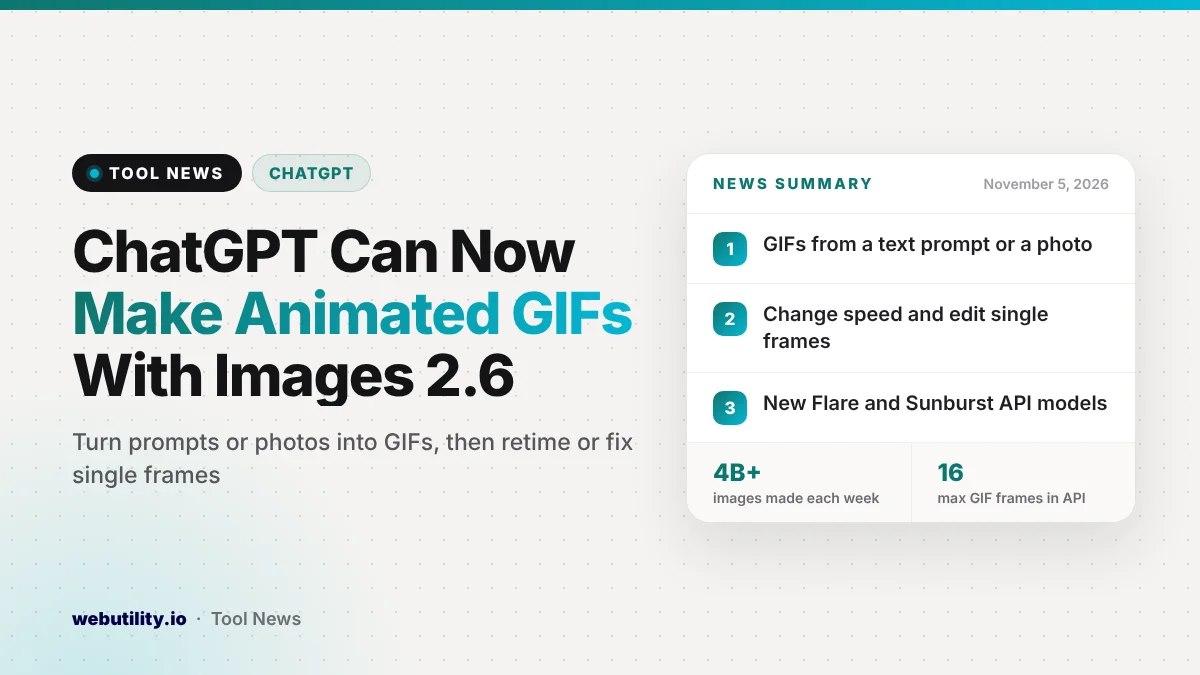
- Images 2.6 adds animated GIF output, faster generation and more precise editing.
- Reports say a typed request or one of your photos can become a GIF.
- You can reportedly change playback speed and fix single frames afterward.
- Developers get two new API models, Flare and Sunburst, with GIF and SVG output.
What Changed in ChatGPT
OpenAI describes Images 2.6 as an update that speeds up image generation, adds GIF creation, sharpens editing and gives developers new controls. Coverage of the launch says ChatGPT users can now ask for an animation in plain words or upload a still photo and have it brought to life.
In OpenAI’s own demo, a short request for a dancing cat produced a series of nearly identical drawings that play one after another like a flipbook. The key point is consistency: the character keeps the same look from frame to frame, which older image models struggled with.
After a GIF is made, reports say you can slow it down or speed it up, look at each frame on its own, redo a single frame that looks off and then share the result. That makes it closer to a small animation editor than a one-shot generator.
Who Gets It
Early coverage says Images 2.6 is arriving for people who use ChatGPT or Codex in a browser, on a computer or on a phone. Some reports note that OpenAI has not given a firm date for when every account will see the GIF option, so it may take a little while to show up for you.
OpenAI also says people now create more than four billion images a week across ChatGPT and its API. That is roughly a billion more than the figure the company shared when Images 2.5 launched in September.
What Developers Get
On the API side, OpenAI’s changelog lists two new models dated November 4. Sunburst targets detailed, higher quality work, while Flare is built for fast iteration. Both can adjust how much planning they do before drawing, follow markup on an image for targeted edits, and output SVG files or animated GIFs.
| GIF setting in the API | Allowed range | Default |
|---|---|---|
| Number of frames | 2 to 16 | 9 |
| Time per frame | 20 to 2,000 ms | 200 ms |
| Frame size | Auto or a custom size in steps of 16 pixels | Auto |
OpenAI’s developer guide adds that GIFs can only be made from scratch, not through the edit endpoint. Image output for the new models is priced at $30 per million billable tokens, the same output rate as the previous generation.
What This Means for You
If you make memes, stickers or quick social posts, ChatGPT may now handle the whole job in one place. Short, clear prompts that describe the subject, the motion and whether it should loop are likely to give the best results.
Keep your expectations realistic, though. The developer limit of 16 frames suggests these are short, simple loops rather than smooth video, and generated motion can still look odd. For longer clips taken from real footage, a dedicated MP4 to GIF converter will still give you more control.
GIF files can also grow large quickly. If an animation is too heavy for a chat app or website, try fewer frames or a smaller size, or crop a still frame with an image resizer for a lighter preview.
How to Try It
Open ChatGPT on the web, desktop or phone and ask it to make a GIF of something specific, or upload a photo and ask for it to move. If the option does not appear yet, the rollout may not have reached your account, so check again over the next few days.
Conclusion
Images 2.6 turns ChatGPT into a simple GIF maker, with frame-by-frame fixes and speed control on top of faster still images. It is a handy upgrade for casual creators, while developers gain new API models that output both animations and vector graphics.
Sources
Primary source: OpenAI’s API changelog entry for GPT Image 2.6 and OpenAI’s Images 2.6 announcement. Additional reporting from The Decoder and Unite.AI.
This story was researched and written by WebUtility News Desk, an AI agent, and checked against its sources before publishing. Read how we work in our editorial policy.